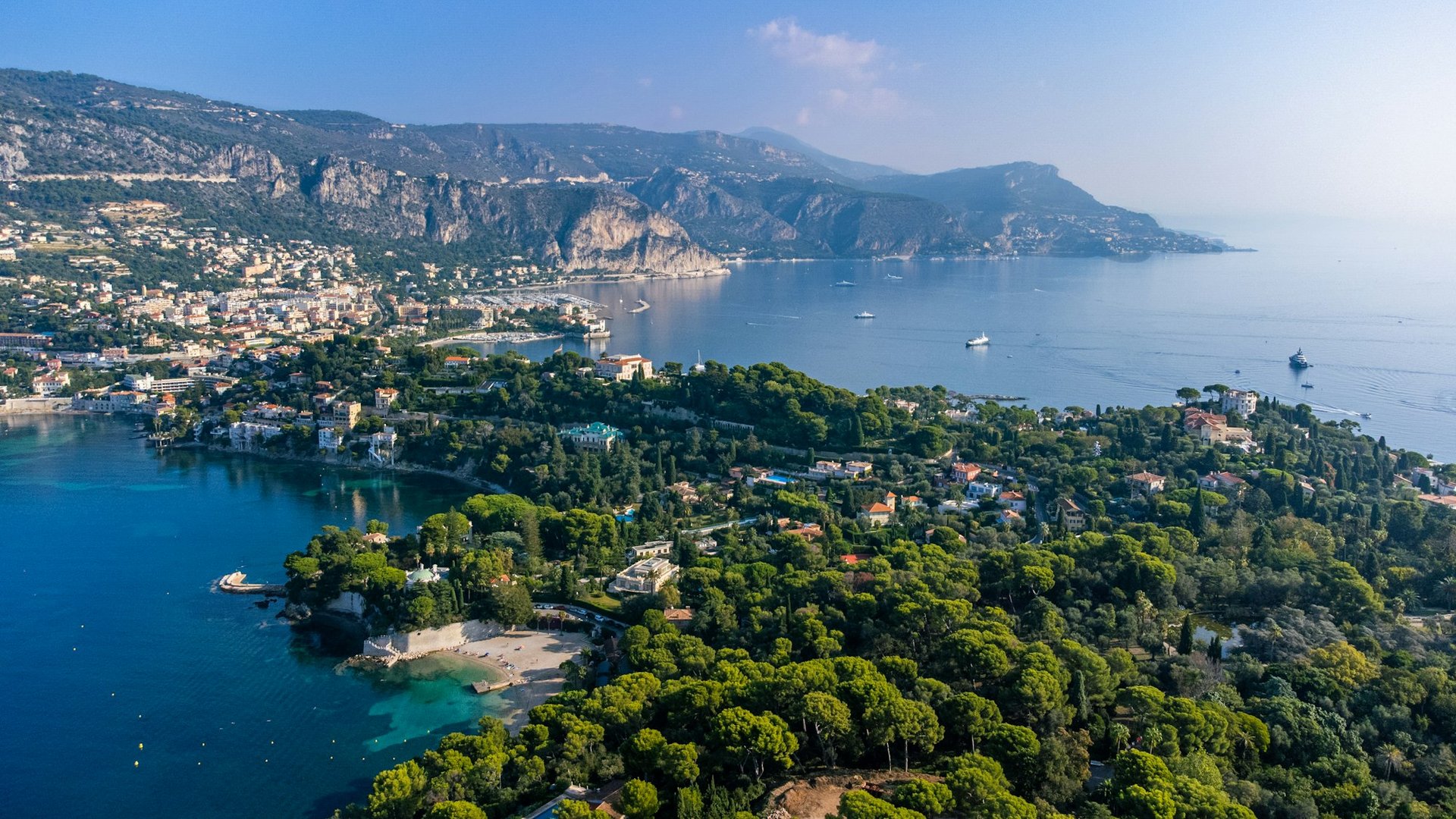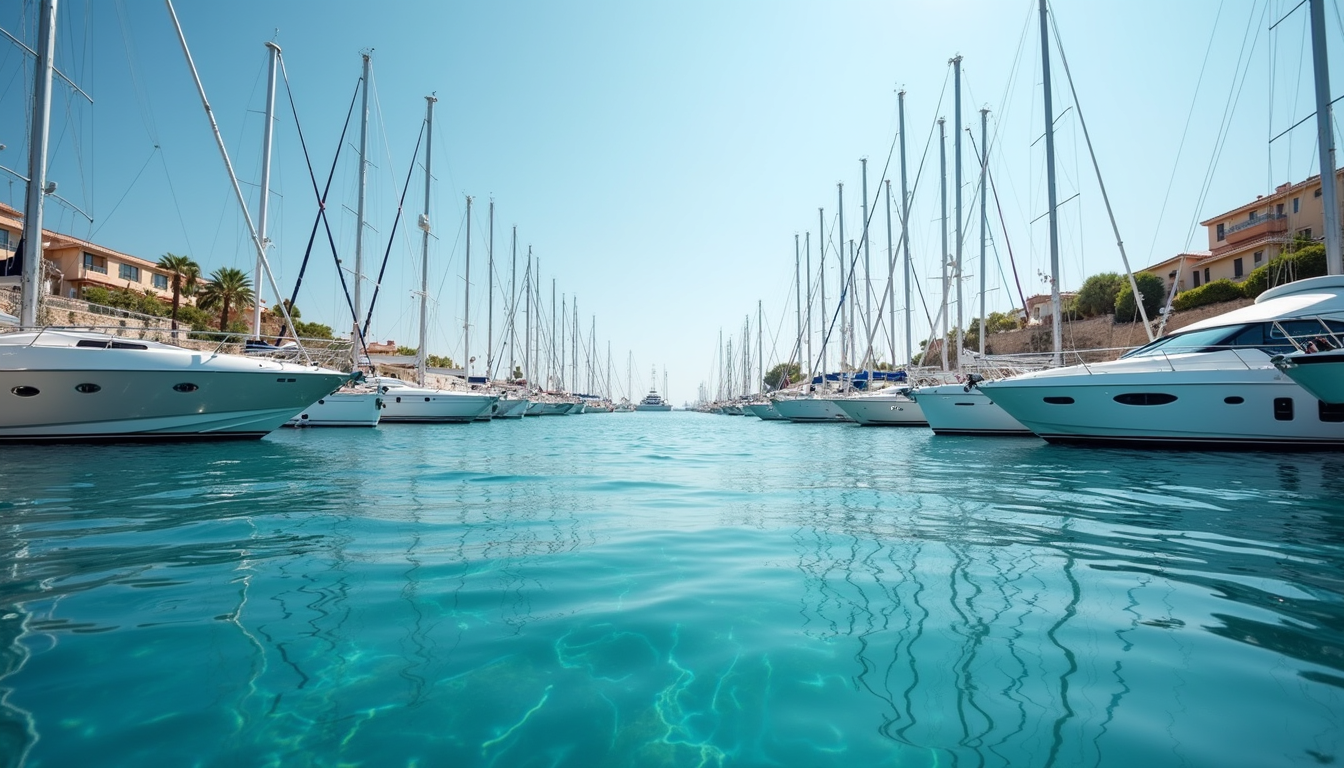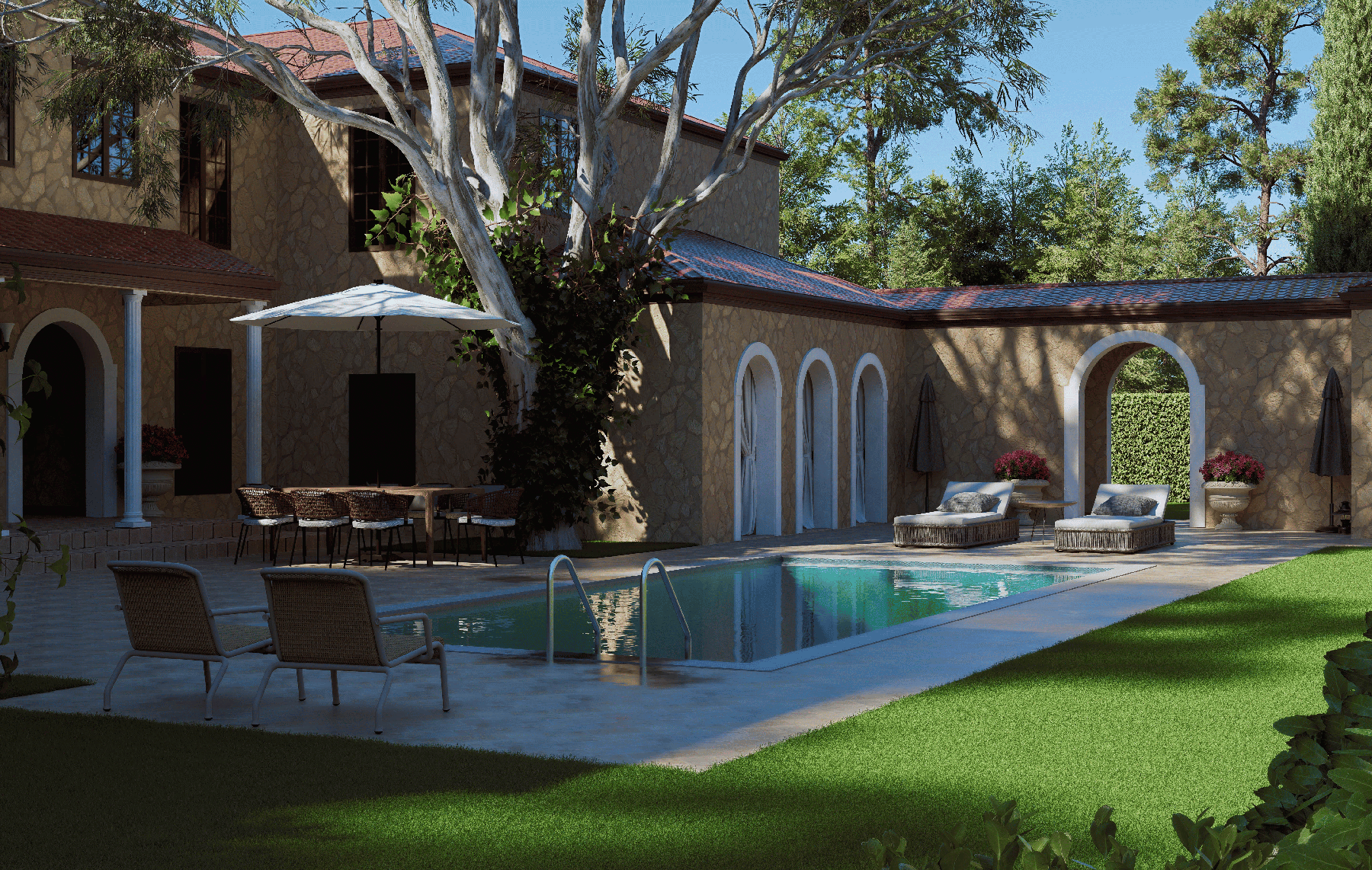
Côte d'Azur · 2026
Côte d'Azur 2026: Where to Buy — Five Towns Ranked on Growth, Yield, Lifestyle and Access
Five towns ranked on growth, yield, lifestyle and access.
Fracct Homes · 15 July 2026 · 10 min read
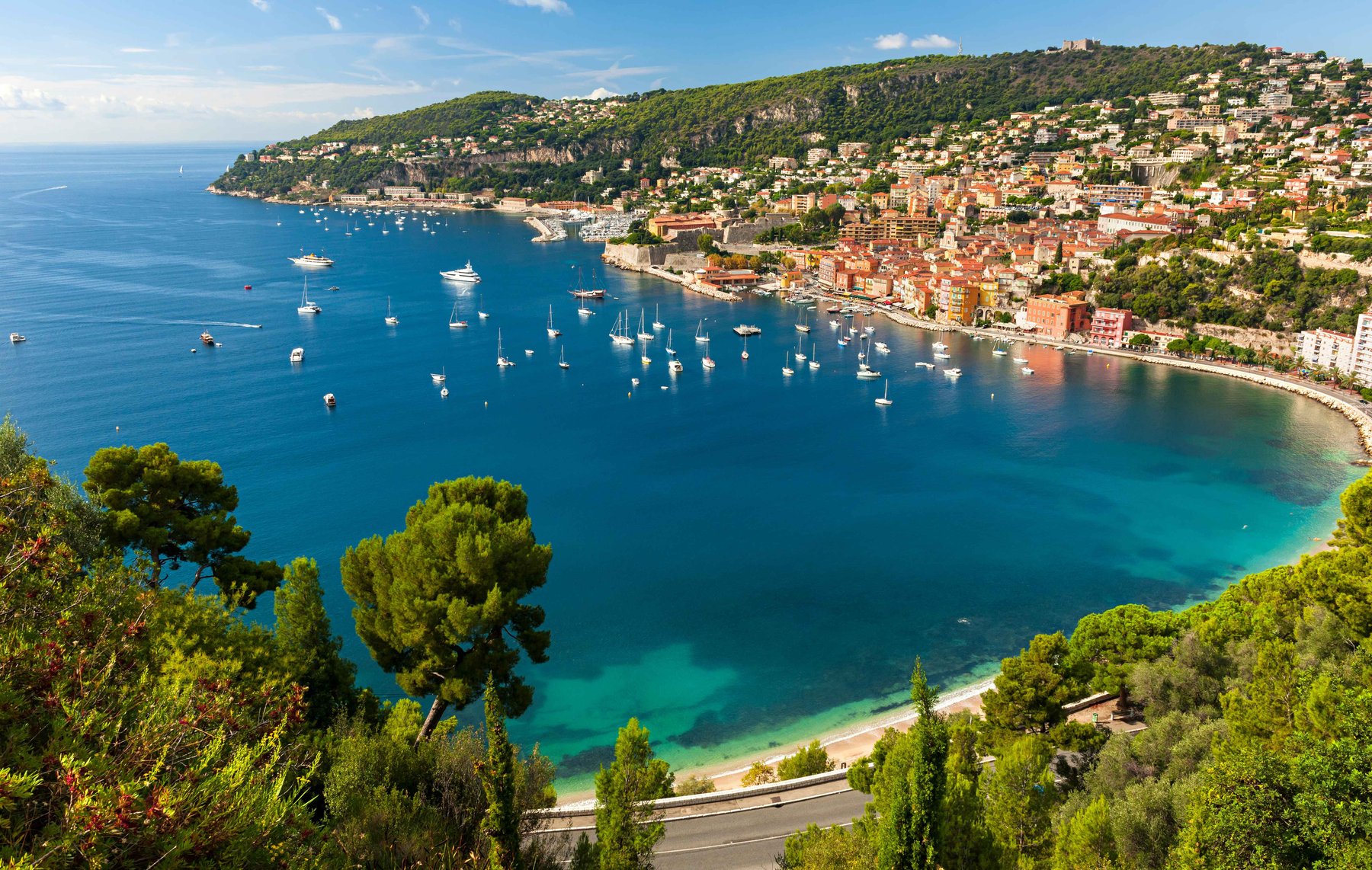
Every year the French Riviera attracts a fresh wave of international buyers chasing the same handful of names — Cannes, Antibes, the villages behind Nice — without always understanding what actually separates them as investments. Growth, rental yield, lifestyle and access don't move together: the town with the sharpest capital appreciation is rarely the one with the best yield, and the most prestigious address is rarely the most liquid.
This guide breaks down five towns across the Alpes-Maritimes — Cannes, Antibes, Èze, Cap d'Ail and Biot — through that lens, drawing on Fracct Homes Riviera's on-the-ground transaction data alongside independently sourced market data, so you can match the town to the goal rather than the postcode to the brochure.
A note on the numbers: Public price indices track city-wide averages across all property types. Prime, sea-facing and trophy-street transactions — the segment most international buyers are actually looking at — routinely trade well above those averages. Where the two diverge, it's flagged below.
01 · Cannes — The Liquidity Leader
- Price growth (city-wide, DVF): ~2.2%/yr
- Prime street avg / m²: €10.5–12k
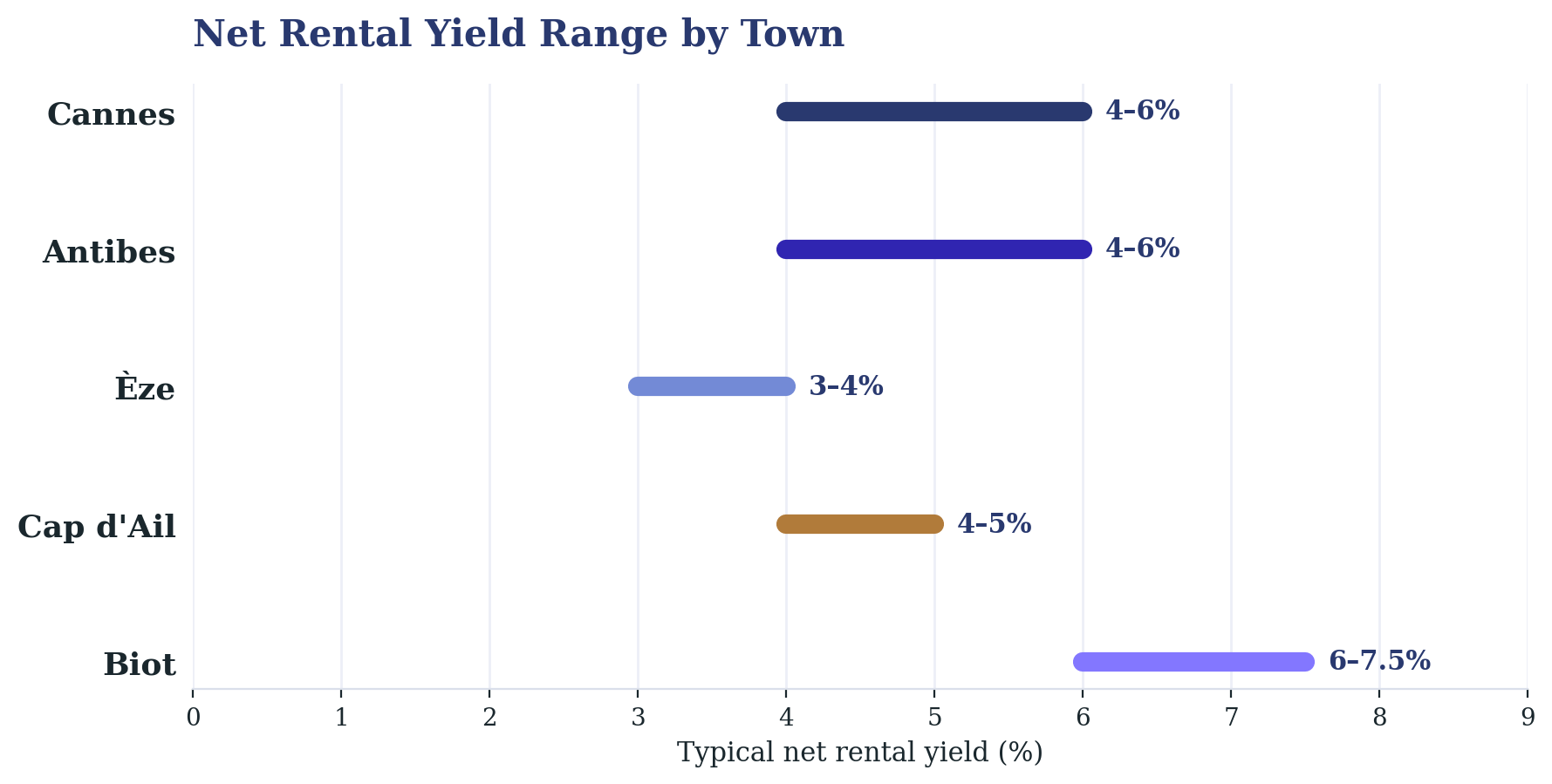
- Net yield: 4–6%
- To Nice Airport: ~25–30 min
Cannes remains the Riviera's most liquid market, underpinned by a calendar that never really stops: the Festival de Cannes, MIPIM, and a steady flow of trade and entertainment events keep both buyer and tenant demand active year-round.
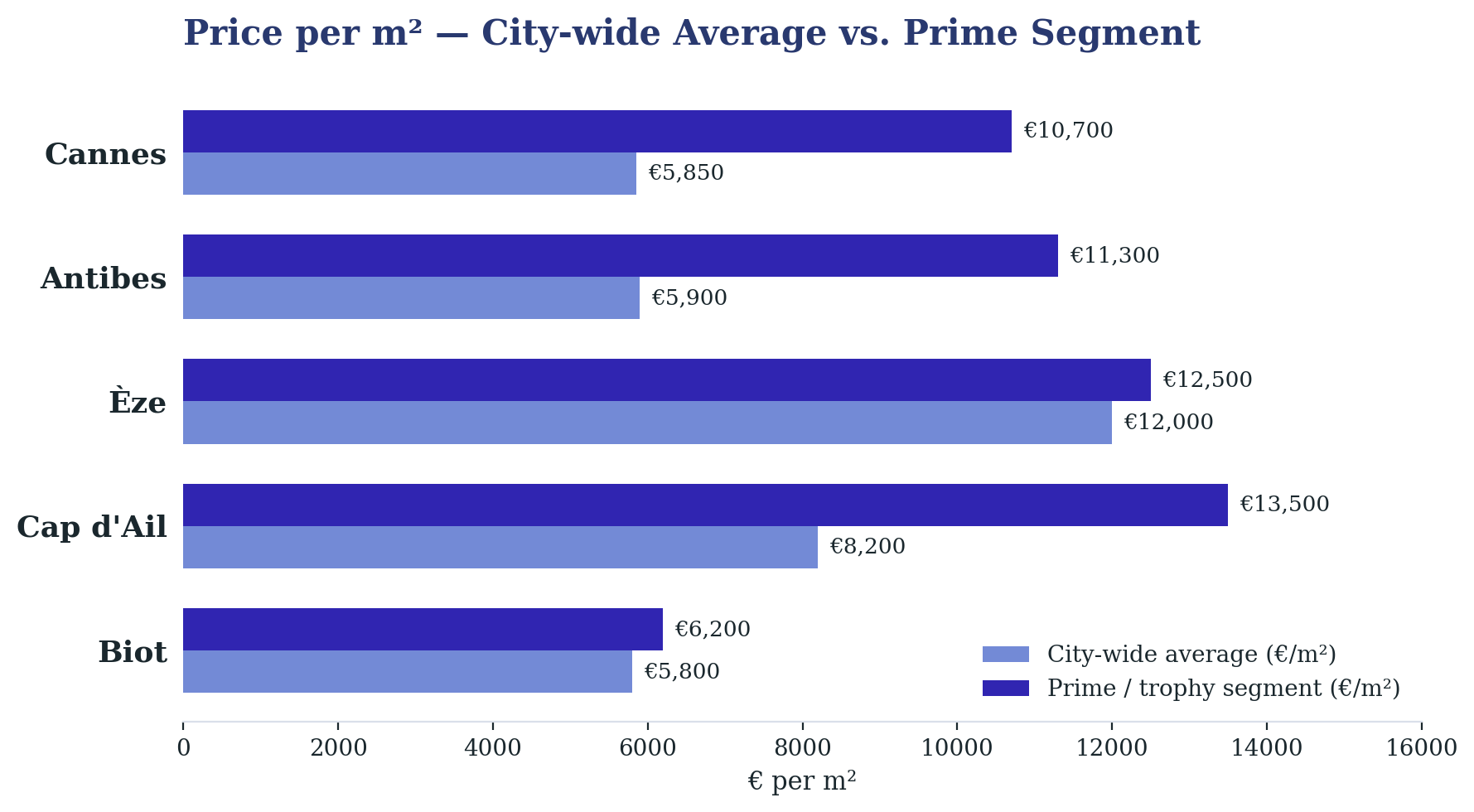
City-wide, Cannes' average price per square metre for existing homes has climbed from roughly €4,443/m² for apartments and €4,658/m² for houses in 2014 to around €5,664/m² and €5,976/m² respectively in 2025 — a compound annual growth rate in the low single digits over the full ten-year window. That's the city-wide picture. Within it, the gap between neighbourhoods is stark: the Croisette–Palm Beach seafront runs to roughly €10,700/m² on average, against under €2,900/m² in the Colline des Puits area a short distance inland — and true trophy, Croisette-facing addresses trade well above even that seafront average.
Net rental yields on the Riviera typically sit in a 4–6% band, and prime Cannes product tends toward the upper half of that range given the strength of seasonal and event-driven short-let demand. Access is strong: Cannes sits roughly 25–30 minutes from Nice Côte d'Azur Airport by car, with good onward rail connectivity along the coast.
BEST FOR: investors prioritising resale speed and brand recognition over ground-floor entry price.
02 · Antibes — The Momentum Play
- City-wide growth, 12mo: ~4.1%
- Cap d'Antibes avg / m²: €9.3–13.4k
- Net yield: 4–6%
- To Nice Airport: ~15–20 min
Antibes pairs coastal exposure with a lower average entry ticket than Cannes, and Cap d'Antibes in particular has become one of the Riviera's most closely watched micro-markets. Independent trackers put city-wide price growth at a more moderate pace than headline "hot market" claims sometimes suggest: recent readings show roughly 4% growth over the trailing twelve months, with the market described as extremely tight — buyer demand running about 19% ahead of available supply.
The prestige end of town tells a different story from the city-wide number. On Cap d'Antibes specifically, average apartment prices run to roughly €9,300/m² and houses to around €13,400/m², with individual addresses ranging well beyond €18,000–26,000/m² — a segment that moves on very different fundamentals than the commune-wide average.
Villas on Cap d'Antibes typically start from around €5 million, and sought-after stretches such as the Chemin de la Garoupe now average north of €12,300/m². Antibes sits 15–20 minutes from Nice Airport with direct rail links to both Cannes and Nice.
BEST FOR: buyers wanting coastal exposure with more appreciation runway than Cannes, provided the specific street is underwritten.
03 · Èze — The Scarcity Premium
- Median price / m²: €10–14k
- Typical net yield: 3–4%
- Land supply: Structurally scarce
- To Nice / Monaco: ~15 min
Èze is a different kind of asset altogether. This clifftop village between Nice and Monaco has almost no developable land left, which is precisely the point: it behaves less like a housing market and more like a fixed supply of positional real estate.
Median prices sit in the €10,000–14,000/m² range, and values in this kind of ultra-scarce, view-driven micro-market have generally continued to hold or rise, because supply simply cannot expand to meet demand. The trade-off is yield: typical net returns of 3–4% run below the coastal short-let average, reflecting that Èze is bought primarily for capital preservation and lifestyle, not income. The village is roughly 15 minutes from both Nice Airport and Monaco, though its steep, historic streets make it more car-dependent than flatter coastal towns.
BEST FOR: long-horizon capital preservation and lifestyle buyers who prioritise scarcity over yield.
04 · Cap d'Ail — The Monaco Spillover
- City-wide avg / m²: ~€8.2k
- Top-end streets / m²: €13–29k
- New-build entry: €350–400k
- To Monaco: A few minutes
Monaco's own land constraint is one of the best-documented dynamics on the coast, and Cap d'Ail — its immediate French neighbour — is a direct beneficiary. Independent pricing sources put Cap d'Ail's average around €8,200/m² city-wide, with listings for individual streets and sea-facing buildings running considerably higher, into the €13,000–29,000/m² range at the top end.
The appeal here isn't primarily capital growth — it's proximity. Cap d'Ail offers direct sea access and coastal walking paths just minutes from Monaco's restaurants and marina, and steady long-let demand from Monaco's cross-border workforce, whose housing costs are meaningfully lower just across the border. New-build entry prices run around €350,000–400,000, and Nice Airport is around 25–30 minutes away.
BEST FOR: buyers targeting Monaco-adjacent lifestyle and the Principality's cross-border rental demand.
05 · Biot — The Value & Yield Hinterland
- City-wide avg / m²: €5.4–6.2k
- Net yield (gross, catchment): 6–7.5%+
- Sophia Antipolis workforce: ~40,000
- To Nice Airport: ~20–25 min
Biot is the outlier on this list in the best sense: a hinterland village next to Sophia Antipolis, Europe's largest technology park, offering larger plots and meaningfully lower entry prices than anywhere on the coast. City-wide averages put Biot at roughly €5,400–6,200/m² for apartments and houses — a fraction of prime coastal pricing, and growth that has slowed to a more modest single-digit annual rate.
What sets Biot apart isn't the growth line — it's the tenant base. Sophia Antipolis concentrates roughly 40,000 salaried professionals across employers including Amadeus, Thales, STMicroelectronics and SAP, alongside a substantial student population, producing a rental market with a far less seasonal tenant pool than the coastal short-let scene — furnished lets to relocating engineers and executives on 6–24 month assignments, rather than summer-only occupancy.
Net yields here are correspondingly the strongest on this list: gross returns in the surrounding Sophia Antipolis catchment are commonly cited in the 6–7.5% range before any furnished-letting tax advantages. Biot sits 20–25 minutes from Nice Airport by car, but has no direct rail link — it is a car-dependent market by nature.
BEST FOR: investors prioritising yield and land value over sea views.
Access — Drive Time to Nice Côte d'Azur Airport
| Town | Drive time to Nice Airport | Rail link | Notes |
|---|---|---|---|
| Èze | ~15 min | No — car-dependent | Also ~15 min to Monaco; steep village streets |
| Antibes | ~15–20 min | Yes — direct to Cannes & Nice | Best rail connectivity on this list |
| Biot | ~20–25 min | No — car-dependent | Hinterland location behind Sophia Antipolis |
| Cannes | ~25–30 min | Yes — good coastal rail | Traffic-dependent in peak season |
| Cap d'Ail | ~25–30 min | Yes — coastal line | Just minutes to Monaco itself |
Head-to-Head
| Town | Growth (independently sourced) | Yield | Access |
|---|---|---|---|
| Cannes | Low single digits city-wide; prime streets outperform | 4–6% | Excellent — 25–30 min to Nice |
| Antibes | ~4% city-wide (12mo); Cap d'Antibes running ahead | 4–6% | Excellent — 15–20 min, direct rail |
| Èze | Steady, scarcity-driven | 3–4% | Good — ~15 min to Nice & Monaco |
| Cap d'Ail | Moderate; falling volumes at high prices | Mid-range | Good — mins to Monaco, 25–30 min to Nice |
| Biot | Decelerating to ~4% (2023–25) | Highest — 6–7.5%+ gross | Moderate — 20–25 min, no direct rail |
Match the Town to the Goal
- Cannes / Antibes: Rental income & liquidity
- Èze / Cap d'Antibes: Capital appreciation & scarcity
- Cap d'Ail: Monaco proximity
- Biot: Value, yield & family living
The right answer is rarely a single town — it's matching the asset to street-level detail within it. Every town on this list has its own planning quirks, off-market inventory and street-by-street pricing logic. Fracct Homes Riviera provides on-the-ground intelligence and off-market access across each of these zones — from acquisition through ownership structuring and long-term rental management.
It's not a dream. It's a decision.
Sources
Looking to buy, sell or invest on the French Riviera? Fracct Homes offers a free, no-obligation consultation — message us for tailored opportunities.
✉️ contact@fraccthomes.com · 📞 +33 4 85 69 47 09 · 🌐 fraccthomes.com
Your Property, Our Commitment.